

The fake rock has been sitting in your garden for years. Or maybe it is the key under the flowerpot, taped inside the mailbox, or perched on the door frame above the porch light. Nearly every homeowner has done some version of this, and nearly every burglar knows it.
Here is the uncomfortable truth: hiding a spare key outside does not really hide it. The spots are so common that intruders check them first, often within minutes. A survey of convicted burglars found that many knew exactly where to look, and the under-the-mat trick might as well be a welcome sign. Keyless entry locks make the whole ritual obsolete, and they solve a few other problems along the way that most people never connect to their front door.
This is not a gadget pitch. It is a look at an old habit, why it fails, and what replacing it actually gets you, whether you live in the home, rent it out, or are getting ready to sell it.
Why the Hidden Spare Key Stopped Working
The hidden key made sense in an era when a key was just a key. If someone found it, they could open your door, but finding it meant guessing, and most guesses were wrong.
Two things changed. First, everyone started hiding keys in the same handful of places. There are only so many convincing spots near a front door, and all of them have been written about, joked about, and shown in movies for decades. Second, homes became more predictable. Builders use similar layouts, and homeowners follow similar habits, so the guessing game got easy.
There is a second problem that gets less attention: the hidden key does not just let strangers in. It lets in anyone who legitimately saw you use it. The contractor you hired for one week. The neighbor’s teenager who watered your plants that one summer. A key under a rock is a key with no memory, no accountability, and no way to turn itself off. You cannot un-share it once the wrong person knows where it lives.
And then there is the everyday failure mode. You lock yourself out, walk to the flowerpot, and find the key is gone, rusted, or was never put back after the last person borrowed it. The backup plan that exists only for emergencies has a way of failing precisely during the emergency.
What a Keyless Lock Actually Replaces
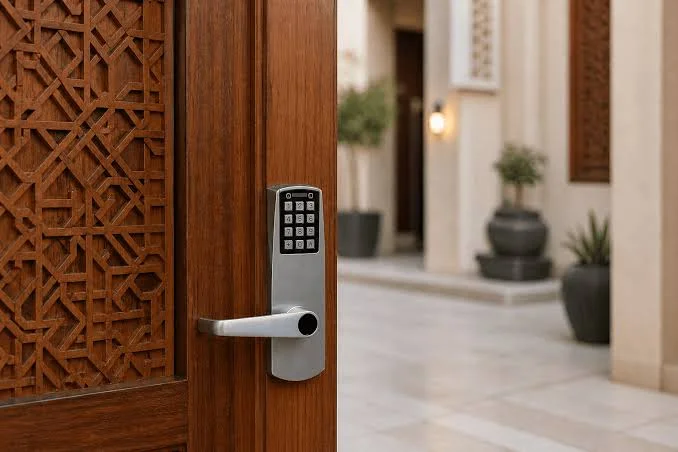
A keyless entry lock is exactly what it sounds like: a lock that opens with a code, a fingerprint, a phone, or a fob instead of a physical key. The keypad deadbolt is the most common version for homes, and it is the one most people picture.
The important shift is not technology. It is what technology lets you stop doing.
You stop carrying a house key, which means you cannot lose it, break it in the lock, or hand a copy to someone who forgets to return it. You stop hiding a spare, because the lock itself is the spare. If your kid gets home from school before you do, they punch in a code. If a friend needs to water plants while you travel, you give them a temporary code instead of a key that quietly stays on their keychain for the next three years.
Codes can also be deleted or changed in seconds. When the housekeeper changes, when a roommate moves out, when a relationship ends, you rotate the code and the old access simply stops working. No locksmith visit, no rekeying, no wondering whether a copy of your key is still floating around somewhere.
The Real Estate Angle: Where This Gets Interesting
If you are in the real estate world, either as a professional or as a homeowner thinking about selling, the spare key problem is bigger than it looks.
Showings and open houses. Listing agents juggle lockboxes, and buyers’ agents juggle codes and keys that get passed around, copied, and occasionally lost. A keyless lock with a temporary code simplifies all of it. Give each agent a code that works only during the showing window, and you have an access trail instead of a key chain.
Moving day. When you buy a home, you have no idea how many copies of the old key exist. The sellers had one, their kids probably had one, a dog walker may still have one, and there could be a spare under a rock in the backyard. Most buyers rekey or change the locks, which is smart. A keyless lock makes the process cleaner: install it once, set your codes, and every old key on earth becomes a souvenir.
Rental properties. Landlords deal with key turnover constantly. Between tenants, at lease renewals, after a lost key report, the rekeying costs add up. With a keypad, turnover is a code change that takes under a minute and costs nothing. Some landlords also assign separate codes to maintenance vendors so they can see who came in and when.
Home value signals. This one is softer, but real. Buyers touring a home notice modern hardware. A keypad deadbolt reads as updated and cared for the same way a smart thermostat does. It is a small detail, but small details shape how people feel about a property, and how they feel shapes what they offer.
The Objections, Answered Honestly
Any honest article has to deal with the doubts, because people raise the same few every time.
What if the battery dies while I am locked out? Keypad locks run on standard batteries that last months, and they chirp or flash a warning well before they die. Most models also have a physical key backup hidden on the underside, so you are never truly locked out. The failure mode is more forgiving than a traditional lock, not less.
What if someone watches me type the code? It happens, but it is manageable. Shield the keypad with your hand the way you would at an ATM. Use a code that is not your address or birthday. Many locks also offer random-digit prefixes, where you press a few extra numbers before your real code so the sequence is never the same twice.
Are they easy to break into? A quality keyless deadbolt is, mechanically, a good deadbolt. The bolt is the same steel bolt that has protected doors for decades. Cheap models exist and are worth avoiding, but the category as a whole is not weaker than traditional locks. Buy from established lock manufacturers rather than unknown brands, and look for models rated by ANSI/BHMA, which is the hardware industry’s standard for strength and durability.
Is it complicated to install? For most standard doors, a keypad deadbolt replaces an existing deadbolt with a screwdriver and takes about thirty minutes. If the door has unusual prep holes or no deadbolt at all, a locksmith can handle it quickly. It is one of the more approachable home upgrades out there.
Getting Started Without Overthinking It
You do not need to replace every door in the house. Start with the door that causes the most friction, usually the front door or the door the kids use, and live with it for a few months.
Choose a code that is meaningful to you but not guessable by others. Avoid 1234, your street number, and your birth year. Set up a separate code for guests and service people so you can delete it without disturbing your own. If the model supports fingerprint access or phone unlocking, add those later once the basics feel routine.
And when it is all set up, do one final thing: go outside and retrieve that old spare key from the rock, the flowerpot, the frame above the door. Throw it in a drawer or recycle it. The spot that has been quietly stressing you out for years is finally off duty.
The Bottom Line
Hiding a spare key was always a compromise, a small bet that the right people would find it and the wrong people would not. It was a reasonable bet fifty years ago. Today it is a habit that costs more peace of mind than it provides.
Keyless entry locks remove the bet entirely. Access becomes something you grant and revoke instead of something you hand out and hope for the best. For homeowners, that means fewer lockouts and no more hiding spots. For landlords and sellers, it means cleaner turnover and one less thing to manage. The front door has been waiting for this upgrade for a long time, and the fake rock can finally retire.
Nguồn: residencestyle