


Most people think a bathroom renovation is about new tile and a fresh coat of paint. I used to think that too, until I lived through a proper redesign and realized how much of the change happens in places you never see in the photos.
The truth is that good bathroom design touches almost every part of your daily routine. The way you wake up, the way you get ready for work, the way you unwind at night. When a bathroom works, you barely notice it. When it doesn’t, you feel it three or four times a day, every single day.
I want to walk through what actually changes when a bathroom gets redesigned with real intention behind it. Not the glossy magazine version. The real version, the one homeowners describe months after the dust settles.
The Morning Routine Stops Feeling Like an Obstacle Course
Before the redesign, mornings in our old bathroom went something like this. One person showering while the other waited, because the layout made it impossible for two people to use the room at once. A vanity so small that everything lived in a plastic bin under the sink. A door that swung into the shower space, so you had to do a little shuffle dance to get in and out.
After the redesign, the room simply flows. A double vanity means two people can brush their teeth without negotiating. A pocket door reclaimed nearly ten square feet of usable floor space. Storage went from one cramped cabinet to a mix of drawers, a linen tower, and a recessed niche that keeps shampoo bottles off the shower floor.
None of these things show up in a before and after photo. But they show up in your stress levels, every single morning.
The Room Got Quieter, and Nobody Expected That
Here is a change almost nobody talks about. Old bathrooms are loud. Loud fans that rattle. Toilets that refill with a shriek. Water hammering through pipes inside walls that were never insulated properly.
A thoughtful redesign fixes all of it as a matter of course. Modern exhaust fans are nearly silent. Pressure balanced valves and properly secured pipes eliminate most of the banging. Insulation between the bathroom and adjoining bedrooms means someone showering at 6 a.m. no longer wakes the whole house.
It sounds like a small thing. It is not. Ask anyone who works early shifts or shares a home with a light sleeper.
Lighting Went From Afterthought to Main Event
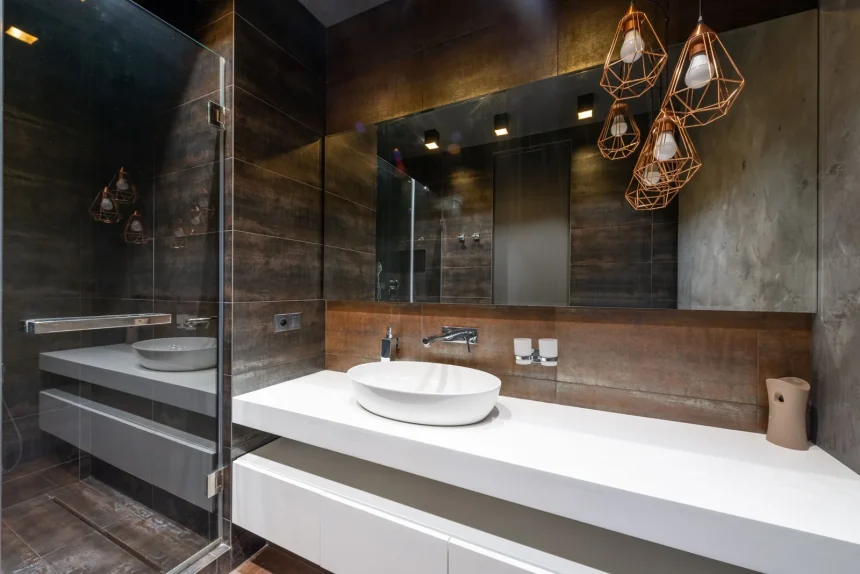
The before picture: a single fixture above the mirror that cast shadows down your face, making every morning look like a horror film. The after picture: layered lighting that actually serves the way the room gets used.
A good redesign thinks about light in three layers. Task lighting at the mirror, placed at face height on both sides so you can actually see what you are doing. Ambient light for general use, often on a dimmer. And something softer for the middle of the night, like a low level path light, so a 3 a.m. trip to the toilet doesn’t require full brightness.
The difference this makes is hard to overstate. Bad bathroom lighting is one of those things people tolerate for years without realizing how much it drags down the feel of the room.
The Bathroom Stopped Fighting the Rest of the House
Before, our bathroom looked like it belonged to a different property entirely. Beige builder grade everything, a vanity that came with the house, and a floor that matched nothing in the hallway.
After the redesign, the room finally feels connected to the home. This is one of the quieter benefits of working with a designer or doing serious planning up front. The materials, the hardware finish, the tone of the paint, all of it can be chosen to echo the rest of the house. The bathroom stops being a standalone unit and becomes part of a whole.
Guests notice this even when they can’t name it. The house just feels more considered.
Maintenance Got Easier, Which Is the Least Glamorous Benefit and Possibly the Best One
Old bathrooms hide problems. Grout that needs scrubbing every week. A caulk line that keeps going moldy no matter what you do. A tap with a drip that returns every winter.
A redesign lets you fix the root causes instead of the symptoms. Larger format tiles mean fewer grout lines. Proper ventilation means mold stops being a recurring character in your life. Quality fixtures with replaceable cartridges mean a drip is a ten minute repair instead of a plumber visit.
Six months in, I realized I was spending maybe twenty minutes a month on bathroom cleaning and upkeep. Before, it was closer to twenty minutes a week. Nobody puts that on a mood board, but it might be the change I appreciate most.
The Value Conversation, Handled Honestly
I would be lying if I said money doesn’t matter here. A well executed bathroom update consistently ranks among the renovations with the strongest return when it comes time to sell. Buyers walk into a dated bathroom and mentally deduct the cost and hassle of renovating it themselves. They walk into a finished one and stop calculating.
But the honest version of this point is that the daily value comes first. If you renovate purely for resale, you end up with a room that photographs well and lives badly. Design for how you actually use the space, and the resale benefit tends to follow on its own.
What Didn’t Change (and Why That Matters)
Here is the part most before and after content skips. Not everything got bigger or more luxurious. The room is the same square footage it always was. We didn’t get a freestanding tub or a rainfall shower the size of a small car.
What changed was the thinking. The layout, the storage, the light, the ventilation, the materials. That is the real lesson of any before and after worth studying. The transformation that matters is rarely about adding more. It is about making what you have work properly.
A small bathroom that functions beautifully will outperform a large one that was styled without thought, every time.
If You’re Planning Your Own Redesign
A few things I would tell anyone starting this process. Live with your current bathroom’s problems for a few weeks and write them down as they happen. The list you build that way will be far more useful than any inspiration board. Spend on the invisible things first, ventilation, waterproofing, plumbing, and good lighting, before you spend on the visible ones. And be honest about how you use the room, not how you imagine you might use it.
The before and after photos will show you a prettier room. What they won’t show you is the morning that runs smoother, the house that feels calmer, and the quiet relief of a space that finally works. That is what a thoughtful redesign actually changes.